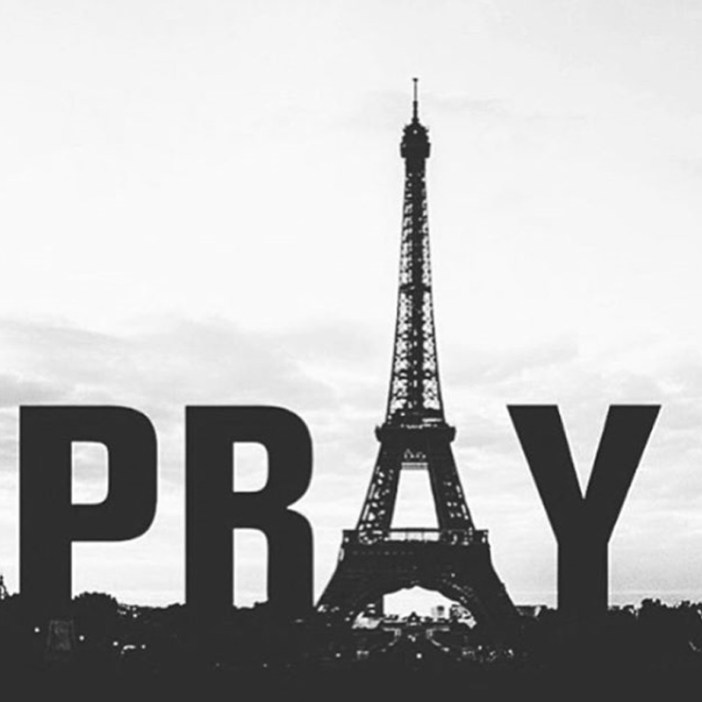
It’s been a somber past few days in light of the terrorist attacks in Paris. When senseless events like this occur, we find ourselves groping about in the darkness, searching for some shred of meaning.
Why did this have to happen?
How could our fellow human beings display such a disregard for human life?
Where was God in the midst of it all?
These are fair questions to be asking, and I don’t believe God begrudges us asking them, even the last one. He’s God, He can take it! While in no way did God have any hand in the tragic events that took place on Friday, I firmly believe that God takes even the most horrific of acts and intends to redefine them for His glory. To quote the Jason Gray song, “In the hands of our Redeemer, nothing is wasted!” So what does God want to teach us through this tragedy? Unlike the biblical prophets, I don’t presume to know precisely what God wants to say at this moment; but as a preacher I am called to proclaim His revealed truth. Since the ultimate way we know God is through His Word, I want to turn to that now in hopes that it can help us as we process Paris.
In doing so, I want to look at scriptures that focus on Jesus’ interaction with 3 of His closest friends and followers: Mary, Martha and Lazarus. We first hear about these siblings when Jesus comes to their village and they invite Him into their home. While Martha is busy acting as a good host to their guest, her sister Mary opts to sit at Jesus’ feet and listen to His teaching. This frustrates Martha who then complains about her sister to Jesus. Jesus’ response to her is, “Martha, Martha, you are anxious and troubled about many things, but one thing is necessary” (Luke 10:41-42b). This text reveals that what truly matters to God is relationship with Him, and yet we too often allow ourselves to get distracted from that. Just before the Paris attacks, which prompted an outpouring of prayers and support on social media (including the changing of Facebook profile pictures to signify solidarity with the Parisians), the hot topic on social media was the Starbucks cup controversy. The unfortunate piece about this chapter in the crusade to “keep Christ in Christmas” is that it will undoubtedly cause Christ to be further rejected by some people. (Now don’t get me wrong, I absolutely want all people to come to the point of making Jesus’ birth their primary focus at Christmastime. But proclaiming that truth is the job of Christians, not Starbucks. So rather than focusing our energy on picking fights with everyone who doesn’t acknowledge Christ during this season, let’s instead redirect that energy toward sharing the hope that we have in Him.) Ok that’s more than enough time spent on that topic, but my point is that Christians can get so distracted with trying to tackle all the potential problems in our world today that we forsake our true calling. As in the case of Martha above, Jesus intends to shift her attention away from the periphery and back to the primary. In a similar way, I believe Christ is using the Paris attacks to reveal what truly matters to Him, and what should matter to those of us who claim His name. Now again, that in no way is meant to suggest that God intended for these attacks to happen. But I do believe that God will work through them to turn our attention away from all the potential distractions in order for us to focus instead on the “one thing” that matters: pointing the world to the Light in the midst of this present darkness.
The second scripture I want to lift up comes later in the story of Jesus’ interaction with these siblings, and it’s found in John 11. Lazarus has become ill and his sisters have sent for Jesus in hopes that He’ll come and heal their brother. But Jesus delays His coming and Lazarus ends up dying. When Jesus does arrive in the village, He’s met by Martha and Mary and not only encounters their grief at the death of their brother, but He also bears the burden of responsibility for Lazarus’ passing, as revealed by them both stating, “Lord, if you had been here, my brother would not have died” (v. 21 & 32). This accusation by these sisters seems to resonate with many in the wake of tragedies, which leads some to surmise that God’s absence is either indicative of His indifference or His nonexistence. As such, Jesus’ response to these sisters continues to be crucial for us today. Verse 35, which is the shortest verse in all of Scripture, is nevertheless one of the most profound. It reads simply, “Jesus wept.” Citing the reason for Jesus shedding tears, it says, “When Jesus saw Mary weeping, and the Jews who had come along with her also weeping, He was deeply moved in spirit and troubled” (John 11:33). Not only was Jesus profoundly present in that moment, but He was also anything but indifferent to their suffering. I believe this verse is crucial for times such as these because it reveals a God who is not indifferent to the loss of human life and the ensuing pain for loved ones. Just as Jesus wept at the death of Lazarus, I have no doubt that He likewise wept at the death of the 129 slain in Paris (and at the death of any of His beloved children). But as this scripture reveals, the tears He shed aren’t solely for Lazarus upon his death, but also for those he left behind. Thus I believe the tears He continues to shed in these moments aren’t solely for the deceased but also for those who mourn their deaths. God is profoundly present in our moments of grief and loss, and just as He wept alongside Mary and Martha, He weeps with you and me as we mourn the deaths of our loved ones.
While the first scripture intends to challenge the distractions that threaten to overshadow Christ, and the second to reveal Christ’s heart amidst tragedies, what remains is to counsel Christians on what our appropriate response should be in the wake of chaos. The common human response at such times is to pray for peace on earth, which obviously is a noble request. However, for those of us who look to the Bible as our guide, we must acknowledge the fact that the Scriptures never promise peace on earth, at least not on this side of Jesus’ return. As such, Christians have a unique word to speak to the world. To discover what that is, we once again turn to John 11 and the exchange between Jesus and Martha. Following Martha’s lamenting the fact that Lazarus died as a result of Jesus’ absence, she nevertheless clings to her faith that her brother will rise again. Then come Jesus’ words, “I am the resurrection and the life. The one who believes in Me will live, even though they die, and whoever lives by believing in me will never die” (v. 25-26). Jesus is here foreshadowing the victory He will achieve over death once and for all through His death and resurrection. Although death will remain a part of life, it will never have the last word for those who are in Christ Jesus. This is the uniquely glorious message that Christians have the privilege of proclaiming to the world. Unfortunately, too often we fail to do so, either because we’ve allowed ourselves to get distracted by peripheral matters or because we succumb to timidity and assume that the world will not be receptive to our message.
The problem with us failing to share our message is that there’s so much is at stake surrounding our response (or lack thereof) in these moments. Turning back to our passage, John tells us that after Jesus raised Lazarus from the dead, people started flocking to their house, not only to see Jesus but also to see the walking dead. When the chief priests learned about this it says that they plotted to kill Lazarus too because “on account of him many of the Jews were going over to Jesus and believing in Him” (12:11). Although none of us will likely share Lazarus’ experience of being brought back to life, the correlation is that people may come to believe in Jesus (or to reject Him) on account of us. As Christ’s followers it’s now we who bear the burden of responsibility for whether or not others will come to know of life eternal in Jesus Christ. I believe that it’s in the shadow of tragic events such as the attacks in Paris, when people are yearning for answers and hungering for hope, that we have the greatest opportunity to share the good news. The question is will we remain silent, hoping that someone else will step up in our place (perhaps Starbucks), or will we boldly step out into these dark places?
Although the world is seemingly becoming increasingly evil, we know (as I recently heard it said) that “God is on His throne, and Jesus is seated at His right hand.” Rooted in that confidence we’re able to face whatever the devil throws at us. When we find ourselves in times such as these, which seem so void of meaning, let us remember that the Spirit of God is hovering over this present darkness and He intends to use us to shine His glorious Light into it. In the case of the Paris attacks, we may feel as though we’re unable to do much more than declare our solidarity through social media and offer up prayers for the victims and their families, given that we’re separated by an ocean. But let us remember that the greatest weapon we have at our disposal is prayer. While our tendency may be to pray generally for peace on earth, I want to challenge us instead to get really specific by praying that hearts will be turned to Christ Jesus, the Prince of Peace. (Yes, that means especially praying for the hearts of ISIS adherents.) Because it’s only when every knee bows and every tongue confesses that Jesus Christ is Lord that this world will ever know peace in its fullness. And while that likely will not happen until Christ returns, it is our mission nonetheless. And in the meantime, for Christ’s sake, let’s remember that He cares so much more about the hearts of His children than He cares about the cup their coffee is in.
 Rev in Real Life